
Finding Hall County Residents
Start with the fact already in hand. A street address points to the Hall County assessment roll and GIS map. A full name belongs in an official index matching the likely event, whether a deed, court case, probate matter, or business filing. Older Gainesville addresses call for the Hall County Library System's digitized directory shelf. Each source answers a narrow question. None lists every adult or household.
The strongest match joins two independent facts. Compare a middle initial, spouse, parcel number, legal description, date, or occupation before linking records. The mailing address is not the situs address. A deed names title parties only. Care matters most when a common surname produces several Hall County residents directory results.
- Search the assessor by owner or location address and record the parcel identifier.
- Check the relevant official name index, such as the court docket, probate docket, or deed index.
- Compare dates, roles, addresses, and stable identifiers across at least two sources.
- Use Gainesville directories and census schedules when the question reaches into the past.
- Ask the correct custodian for an existing record when the online trail ends.
Hall County Directory Custodians
Hall County splits its resident records among several offices. The Clerk of Superior and State Courts keeps trial-court files, deeds, liens, plats, trade names, and personal-property records. Probate Court handles estates, guardianships, and marriages. The Board of Assessors publishes the current parcel roll. Elections maintains voter registration for Hall County and its municipalities. Gainesville keeps its own city court, permit, and municipal files, so a county request cannot replace a city request.
Addresses get their own page. The Hall County street directory handles that route. Send each request to the office that created the record, not merely the government named in the mailing address.
Hall County Property Roll
The assessor is often the quickest way to connect a Hall County address with a titled owner. The Hall qPublic Parcel and Assessment Search supports owner, address, and parcel-number searches. A parcel card can show plenty. Expect the owner's mailing address, situs address, legal description, subdivision or lot references, value components, sales history, building facts, exemptions, and a map link. Hall's GIS page says the data updates weekly.
| Search mode | Best input | Record to capture |
|---|---|---|
| Owner Name | Surname and variants | Owner form and parcel ID |
| Location Address | Street number and name | Situs and legal description |
| Parcel Number | Tax notice or GIS ID | Exact parcel card |
| Map | Selected parcel | Adjacent parcels and layers |
The Hall Tax Assessors service page leads back to the office behind the roll.
This source provides the official contact route when a parcel result needs explanation or correction. Ownership is not proof of occupancy. The two addresses can differ for many reasons. An exemption is not a household list either. Note: qPublic's weekly cycle, a deed's recording date, and a directory edition represent three different points in time.
Hall Deeds Reach to 1818
Hall's land records run deep. The clerk says land and personal-property holdings date to the county's founding in 1818. The GSCCCA index searches recorded instruments by county, party name, and instrument type. It also covers book and page, file number, and recording-date range. Its uniform statewide real-estate index begins in 1999. Older Hall books reach much farther back. Exact online image coverage before 1999 is not officially stated.
- Index
- A finding list that points to a record.
- Parcel
- A mapped unit of land with a stable local identifier.
- Grantor and grantee
- The party giving an interest and the party receiving it.
- Certified copy
- A copy authenticated by the record custodian.
When an image is missing, write down the book, page, instrument number, and parties. The Real Estate Division's counter can supply copies. Certified electronic copies may be ordered through eCert. A free limited GSCCCA account searches summaries only. It cannot view or print images, and product charges should be checked at use time.
County history reports fires in 1851 and 1882, when residents saved historic records and valuables. The 1936 tornado damaged the courthouse and city-hall district. Those events do not prove every series is complete, so inspect each book rather than assuming a continuous digital run.
Current Hall County Resident Rolls
Modern Hall County residents directory work compares limited official rolls. Pick the roll whose purpose fits the question. Confirm any result elsewhere. Commercial people-finder products may combine old public and commercial data, but records can be stale or merge names, while official sources reveal their custodian, update pattern, and copy route.
| Official source | What it establishes | Access | Main limit |
|---|---|---|---|
| qPublic roll | Titled owner, parcel, mailing and situs | Free web search | Not a household roll |
| Hall court docket | Party, role, case, date, status | Public index | Restricted files absent |
| GSCCCA deed index | Recorded property parties and events | Account and counter | Title does not prove occupancy |
| My Voter Page | One voter's registration and districts | Identity-based lookup | Not browsable by street |
| SOS business search | Entity, agent, status, filings | Free basic index | Business address may not be a home |
For one-person research, narrow the name first. Use dates, roles, and a stable identifier before comparing it with another official index.
Hall Court Names Need Context
The Hall Superior and State Courts docket takes a party name or case number. Court, case type, and date filters may also apply. A typical result lists the case number, division, case type, filing date, parties and roles, docket events, attorneys, and status where entered. It is a lead, not a certified disposition. Adoption, juvenile, and other restricted material stays out. Search spelling variants and preserve suffixes or middle initials. Compare the case date, role, court, attorney, and any lawful address reference with a separate record. Hall Probate Court uses Georgia Probate Records for most estate cases filed after 2010. Gainesville Municipal Court allows requests but no name-browse. The Hall Probate Court overview leads to estate, guardianship, and marriage access.
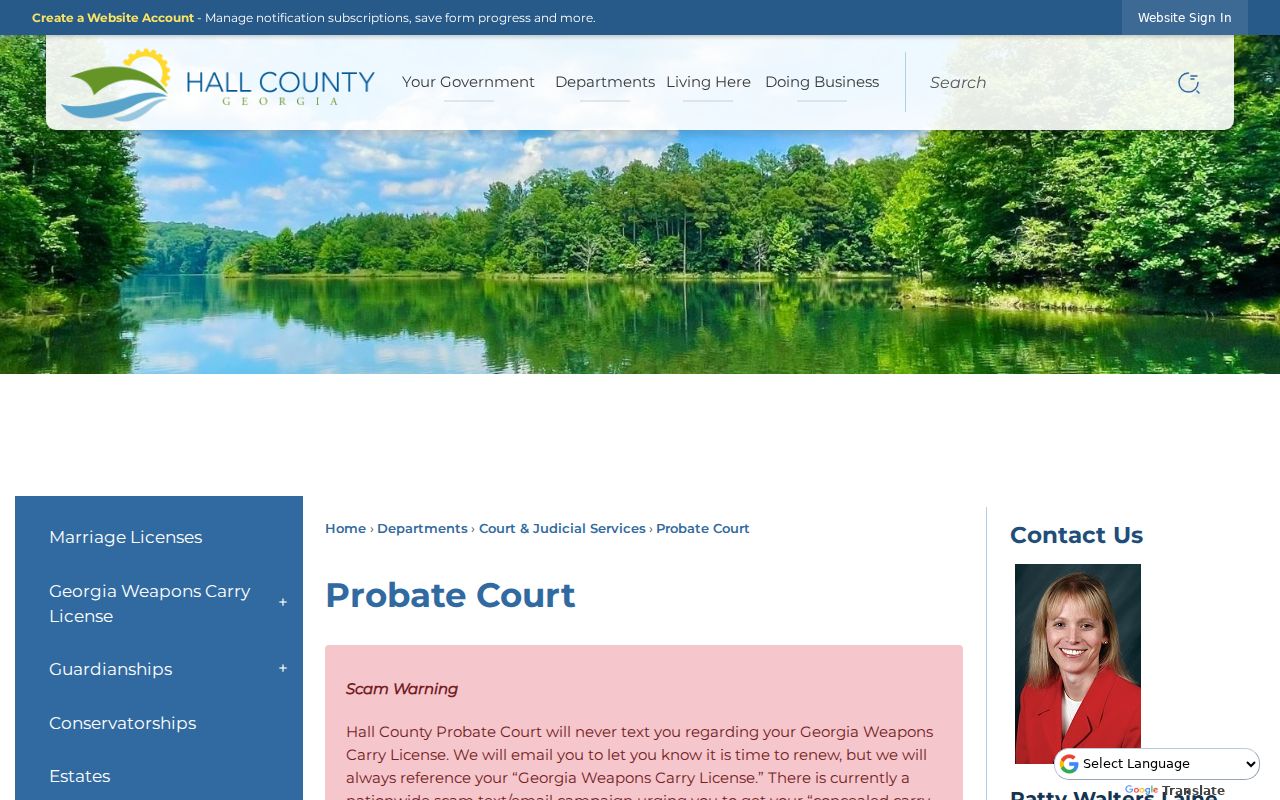
This source separates probate records from the clerk's docket.
Hall Voter Lookup Boundaries
Hall Elections keeps the voter rolls for the whole county. Every city and town inside it is covered. For a personal check, Georgia offers My Voter Page. You enter a name, pick Hall County, and add a date of birth. A match then displays registration status and polling place. It also shows precinct, districts, and elected officials, plus sample ballot and absentee tools. Ballot choices stay private. The tool also cannot walk a street and list every voter living there.
The page's form illustrates the identification route Georgia uses for an individual registration check.
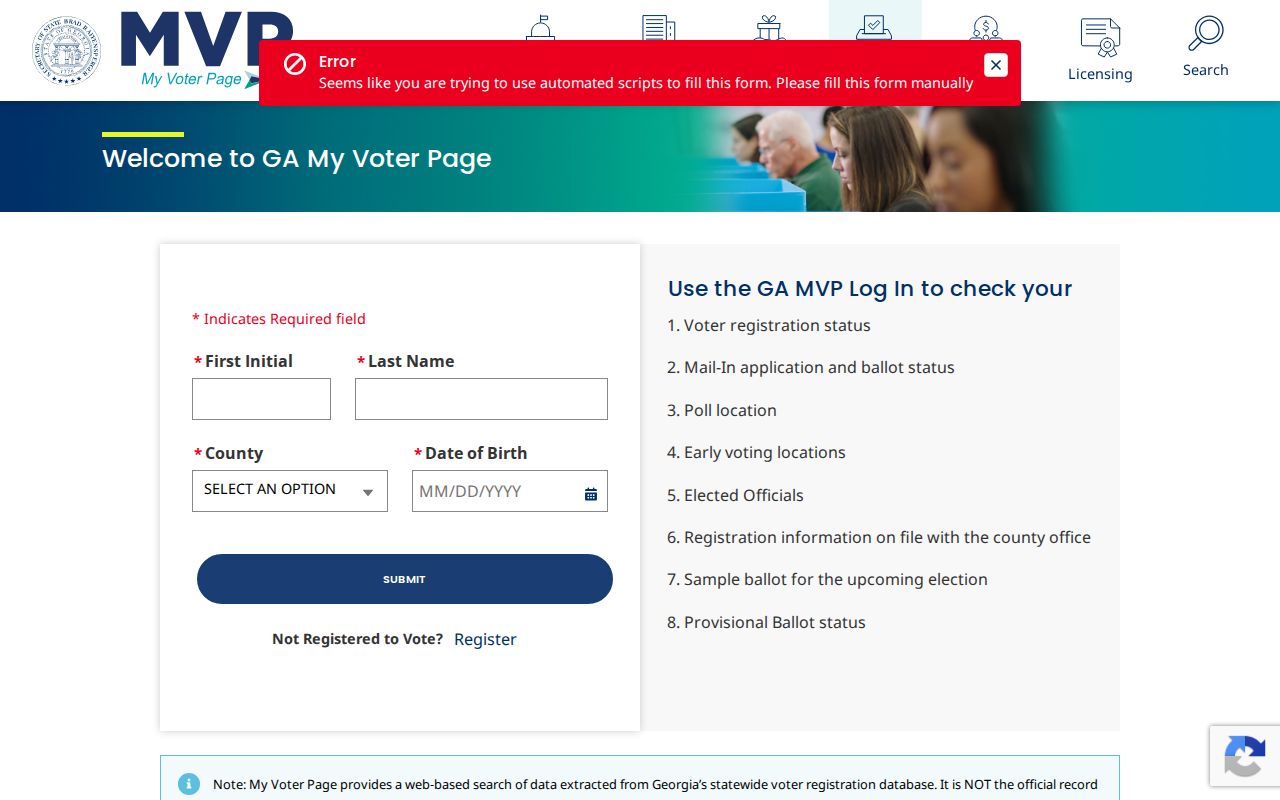
The form's limits matter. An unsuccessful search is not proof that a Hall County resident moved or is unregistered. Georgia regulates public voter files under O.C.G.A. § 21-2-225. Hall links to official ordering, which supplies defined products and omits protected data. Georgia does not register voters by political party.
As of August 1, 2026, Hall Elections reported 157,466 registered voters, 31 precincts, and more than 500 poll workers. Those figures show why an individual identity check and a regulated list order are distinct tasks.
Hall Vital Records Access
Vital records will not fill the role of a Hall County residents directory. Birth, death, marriage, and divorce certificates sit behind restrictions under O.C.G.A. §§ 31-10-25 and 31-10-26, which demand identity proof or a qualifying relationship. Locally, Hall County Vital Records issues birth and death certificates. Probate Court supplies marriage copies. Superior Court keeps the divorce files.
Proof and discovery are different tasks. An obituary, docket, or old directory entry can point you toward an event, yet none of them replaces the certified certificate. Hall's marriage form wants both parties' names, the date and place of marriage, requester contact details and signature, identification, payment, and a return envelope. Each certificate or application copy runs $10.
Gainesville adds a rare historical wrinkle. Georgia Archives holds a partial municipal birth register covering 1908 through 1911, years before statewide registration began in 1919. Treat that register as a lead, not a complete record, and pair it with census, probate, church, or directory evidence.
Gainesville Postal Lines Mislead
A Gainesville mailing address does not guarantee the property sits inside incorporated Gainesville. That line matters. It decides which office holds permits, code files, and certain court records. Postal labels fail as a test of jurisdiction. South Hall keeps growing near Flowery Branch and Oakwood. North Hall communities sit near Clermont and Lula. Gillsville lies in the east, and Lake Lanier shoreline development stays steady.
Check Hall GIS layers before filing anything. The parcel and its municipal context become clear that way. Hall County handles permits in unincorporated areas. Each municipality governs its own. The street address still helps. But the parcel ID, the city boundary, and the legal description route a records request far more safely.
Note: One Hall County address can carry a mailing city, an incorporated city, and a county parcel jurisdiction that describe three different geographies.
Hall Records Requests Changed
The Georgia Open Records Act, O.C.G.A. §§ 50-18-70 through 50-18-77, lets anyone ask for an existing public record. No special wording is required. Custodians must respond within three business days. They either produce the records, or they state when the records will be ready and what they should cost. Agencies have no duty to build a new resident list or custom report.
On July 1, 2026, most Hall departments moved their requests to NextRequest. Elections, Environmental Health, the Sheriff's Office, and the courts still run separate channels. A strong request names the office and the record type. It also gives the person or address, plus a narrow date range. The first 15 minutes of labor are free. Retrieval, redaction, and copies beyond that may add cost. The county's open-records request page points you to the right channel for each records office.
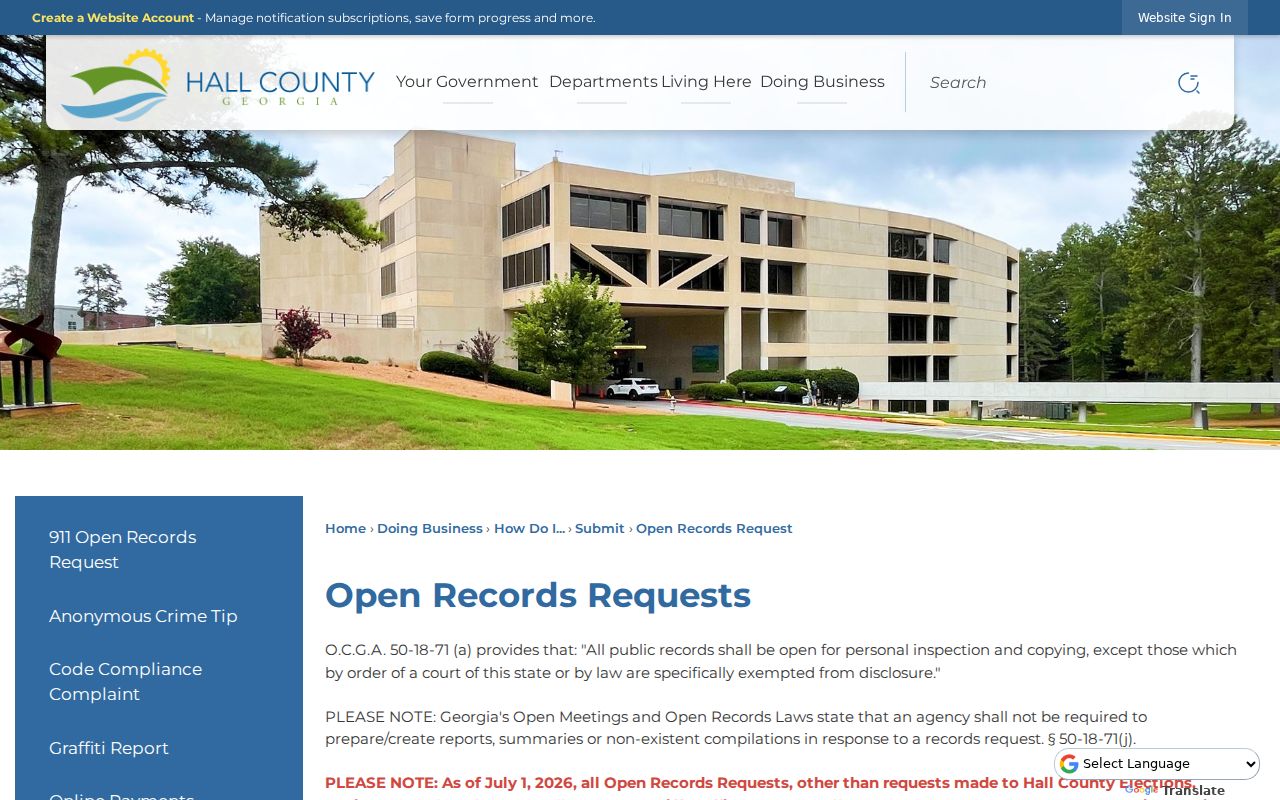
Some Hall County records exist but carry no public name or address index. For those, the routing screen becomes the fallback, pointing requesters to the office that holds the record itself.
Hall Filing Alerts Are Free
Hall County joined with GSCCAA to launch the Filing Activity Notification System, known as FANS. The announcement came on March 25, 2026. Owners opt in electronically. They receive notice when a filing appears under a chosen name or record. The service is free. It is also voluntary. Alerts carry no guarantee of completeness or accuracy. So each one prompts inspection of the official filing rather than replacing the deed index. The official Hall FANS announcement walks through signup and the warning that comes with it.
The notice also helps residents distinguish the county's no-cost alert from paid property-fraud solicitations.
Historical Hall County Directories
Old city directories put Hall County households on the record back to the 1880s. Two collections carry the early years. The Hall County Library System and the Digital Library of Georgia both offer searchable Gainesville editions. These run from 1882 through 1960. Publication was not annual. Confirmed editions include 1882-83, 1911-12, 1913-14, and 1918. More volumes follow. There is a string of 1920s through 1940s editions, and Polk editions from the 1950s into 1960. A single entry can hold a lot. It may list a name, occupation, spouse, employer, and home address, plus abbreviations the edition itself defines.
Search the OCR text first, then read the scanned page. Machine text garbles names and street numbers. Later Polk volumes also list Gainesville Mill, New Holland, and Chicopee separately. Someone missing from a narrow Gainesville search may surface under a mill community instead. The Hall County city directory collection covers the full shelf of editions. The Hall County Library System stays the local entry point for directories, newspapers, yearbooks, family histories, and staff help.

An ordinary web search will not surface every digitized edition or reverse directory. When it comes up empty, the library route is the one that matters for Hall County.
Protecting Hall County Addresses
Not every Hall County address is open to the public. Georgia Safe at Home, found at O.C.G.A. § 50-18-150 et seq., gives qualifying survivors a substitute mailing address. VoteSafe shields the voter-address information of voters who qualify. Hall County also publishes a sworn form under O.C.G.A. § 50-18-78, letting certain protected officials and workers cut the online tie between a name and a property address in county records.
Suppression only changes what a search displays. It does not erase a deed that is otherwise public in the county recorder's records. Factual errors belong with the custodian that maintains the record, while sealing, restriction, and redaction turn on the law governing that series. Removing an entry from a commercial directory is a separate step, and it may need repeating as the data reappears.