
Hall County Directory Editions
The Hall County Library System holds Gainesville city directories that are freely searchable through the Digital Library of Georgia. The collection's outer span is 1882 through 1960, but it is not a continuous annual run. Each surviving edition has its own publisher, scope, layout, and abbreviations. The table preserves those differences and identifies the real access channel.
| Collection | Years | Where Held | Access |
|---|---|---|---|
| C. M. Gardner city and business directory | 1882–1883 | Hall County Library | Free DLG text and PDF |
| Grady H. Gaston, Vol. I | 1911–1912, 1913–1914 | Hall County Library | Free DLG scans and text |
| Gainesville City Directory Co. | July 1918 | Hall County Library | Free DLG scans and text |
| Mann and Miller editions | 1926, 1928–1929 | Hall County Library | Free DLG access |
| City Directory Co. and Baldwin | 1937, 1939, 1940s | Hall County Library | DLG collection facets |
| R. L. Polk Gainesville/Hall | 1952, 1956, 1959, 1960 | Hall County Library | Free DLG access |
No official source established physical shelf ranges for reverse books, phone books, yearbooks, or obituary indexes. Ask Hall County Library System staff about unlisted holdings. Missing years can reflect survival or digitization gaps, so a blank year does not prove that a family left Gainesville.
Search Gainesville Directory Scans
The Digital Library of Georgia collection offers full text and page images. Begin with a surname, then try initials, spelling variants, hyphen changes, and likely OCR errors. Open the scan for every hit. Machine text can drop a letter, merge columns, or turn a house number into a word. Save the book title, printed page, and stable item link with the transcription.
The public-library digitization project turned 17 volumes and about 5,500 pages that had been onsite-only into a statewide search source. The Georgia Public Library Service project account describes entries with names, addresses, spouses or marital notes, occupations, and businesses.
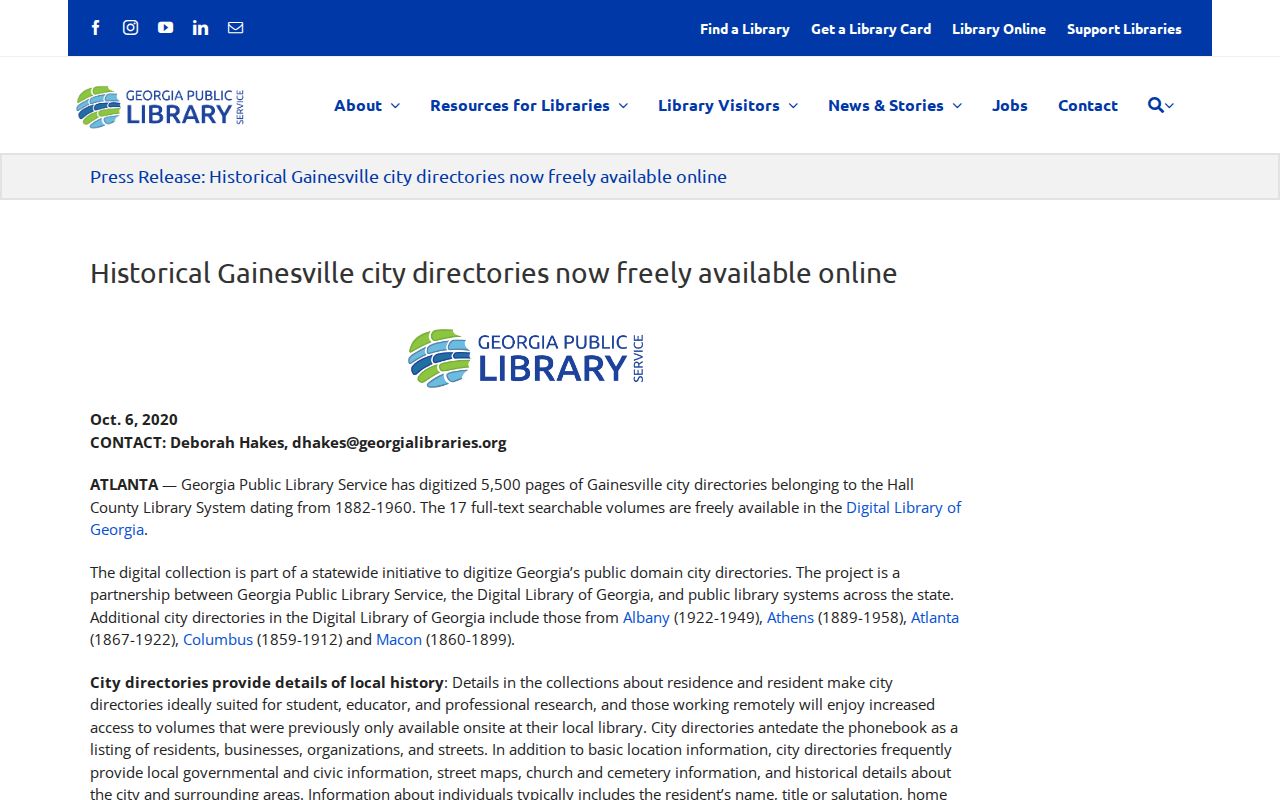
The captured project page explains the scope of the digitized shelf and why the original printed image still controls over uncorrected search text.
Note: Treat the DLG year list as surviving editions, not a promise that every year within the outer span exists.
Hall Directory Formats Changed
Seven publisher identities appear across the confirmed set: Gardner, Gaston, Gainesville City Directory Company, Mann, Miller, Baldwin, and Polk. That succession matters. A mark used in one book should not be imposed on another without checking the latter volume's key. Front matter also reveals whether the book includes alphabetical residents, businesses, streets, institutions, or only some of those parts.
| 1882–1883 | Earliest confirmed digitized Gainesville edition. |
|---|---|
| 1911–1918 | Gaston and the local directory company add civic, business, and institution sections. |
| 1926–1940s | Mann, Miller, City Directory Company, and Baldwin formats change the organization. |
| 1952–1960 | Polk editions widen named geography to mill communities. |
Compare like facts, not page layouts. Name, spouse, occupation, employer, home marker, and telephone may appear in a new order. Read the contents and abbreviation page before deciding that a field is absent.
Decode Hall City Directory Entries
A printed resident line is compact evidence. One 1952 pattern places a name before “emp,” an employer, “r,” and a numbered street. Another places a spouse in parentheses, uses “h” for home, and adds a phone. That line describes one listed adult or business, not every person at the address.
| Name | Surname, given name, initials, and sometimes a marital honorific. |
|---|---|
| Family clue | A spouse may appear in parentheses; “wid” can identify a deceased spouse. |
| Work | Occupation, employer, manager role, or business affiliation. |
| Residence | “r” for resides or “h” for home, followed by the printed address. |
| Contact | Telephone where the edition supplies one. |
- Criss-cross directory
- A street-order section that reverses the usual name-first arrangement.
- Householder index
- A list centered on the person associated with a home, not a full household census.
- Abbreviation key
- The edition-specific legend defining short forms such as “wid,” “h,” “r,” “emp,” and “mgr.”
An employer can help separate two people with the same name. A business location may sit next to a residence. Transcribe the punctuation and then test the entry against another dated source.
Hall Mill Communities Join
Later Polk volumes change the geography of the city directory. The 1952 and 1956 editions explicitly include Gainesville Mill and New Holland. The 1959 and 1960 editions add Chicopee. Someone absent from a narrow Gainesville search may appear under a mill community treated as its own directory area.
The books preserve more than an address. Business and institution sections can connect a resident to a mill, church, club, school, or local service. Use that affiliation to distinguish names, but confirm residence from the resident entry. Do not force today's neighborhood labels onto the printed volume.
Map Hall Directory Addresses
The 1913–14 Gainesville directory contains an official map with concentric one-eighth-mile circles, street railway routes, and rail lines. It can translate an old address described through a transit route. The January 1903 Sanborn map at DLG and the April 1915, 14-sheet atlas at the Library of Congress add footprints, house and block numbers, lot lines, materials, hydrants, and building uses.
Maps do not name occupants. Pair the printed address with the right sheet, then compare it with a second directory or deed. Gainesville Sanborn editions are also verified for 1886, 1888, 1893, 1898, 1909, and 1922. Their dates help bridge gaps in the city directory run.
Gainesville Directory Community Lists
The July 1918 volume reaches beyond the alphabetical roll. Its contents include fraternal groups, clubs and societies, churches, cemeteries, schools, and commercial organizations. These time-stamped lists can suggest a congregation archive, school record, cemetery register, or society history when a resident line goes cold.
A printed listing confirms that an organization appeared in that edition. It does not make modern membership public. The Hall historical photograph and Black History Society collections can add named people, buildings, schools, churches, businesses, and civic events. Verify captions against the city directories, newspapers, or census.
Hall's Rare Birth Register
Gainesville kept an incomplete municipal birth register from 1908 through 1911, before Georgia's regular statewide registration began in 1919. Georgia Archives preserves it on microfilm. This local record island can support a family link near the 1911–12 city directory, but the Archives calls the register incomplete. Absence proves little.
Pair an entry with the 1910 census, directories, church material, probate, or a later death source. Current certificates remain controlled records, so historical discovery does not remove eligibility rules. The goal is corroboration across dated sources.
Hall Directory Companion Sources
Several local collections can solve questions that a city directory leaves open. The Hall County historical photograph collection carries captions for people, buildings, and events from library holdings. The Hall County Black History Society photograph collection spans 1901 through 2001 and is strongest in the 1940s and 1950s. It documents leaders, businesses, schools, churches, and civic groups. A caption provides a lead, not final identity proof, so compare its date and place with the closest directory edition.
Georgia Historic Newspapers offers an official Hall browse from 1861 through 2025. Among its title runs are the Gainesville Eagle from 1875 through 1914 and the Gainesville News from 1902 through 1922. Search a narrow title and date span after a directory supplies an occupation, business, or street. Verify newspaper OCR on the page image just as carefully as directory text.
Brenau University archives and Hall-area school yearbooks can help with classmate or faculty research, though published pages did not establish exact yearbook runs. Brenau's noncirculating special collections are appointment resources. Ask the repository about the person, institution, date, and access terms rather than assuming a student directory is public or complete.
Hall Records Survived Disasters
Hall County was formed in 1818, and the clerk still reports land and personal-property records reaching that founding. Gainesville courthouse buildings faced fires in 1851 and 1882, when residents saved historic records and valuables. The 1936 tornado later struck the courthouse, city hall, and business district. Building damage does not support a claim that every record series is complete. Ordinary and other series must still be checked book by book.
This history explains why a city directory should be paired with courthouse material. A directory places a person at a printed address for one edition. Deeds can follow ownership through legal descriptions, while court and probate books may explain a widow notation or estate transfer. Online absence is not the end of the trail because many older series require a catalog, microfilm, general index, or counter request.
Trace Hall Families by Directory
Family research works best when each Hall County city directory hit is saved as a dated observation. Preserve the exact spelling, initials, address, work, spouse, and page. Then move in both directions through surviving books. A changed address with a stable employer may show a move, while a widow notation can lead toward death, probate, newspaper, or cemetery evidence.
- Search the surname and OCR variants. Open the scan and transcribe the full line.
- Check the key, business section, and any street section in that edition.
- Move to the prior and next books. Note moves, work changes, spouse entries, and gaps.
- Compare the 1900 through 1950 public federal census schedules. The 1950 schedule is the newest public one as of 2026.
- Map the address with a directory map or Sanborn sheet, then use deeds when title matters.
- Close a deceased person's trail with obituary, probate, death, or cemetery evidence.
Disappearance may mean death, a move, omission, changed spelling, or residence outside that edition's scope. The mostly destroyed 1890 federal population schedules create another gap, making the 1882–83 volume and 1903 map valuable bridges. For a current parcel chain, use the Hall County street directory instead of reading a historic book as present-day evidence.
Keep negative searches in the log as well. Note the exact edition, spelling attempts, and sections checked. If a surname is absent, try the employer, business class, spouse, address, mill community, and nearby census year. Married names can surface through an obituary, while a city cemetery result can fix a death date for the next newspaper or probate search. Two independent sources reduce the risk of merging people who shared a name.